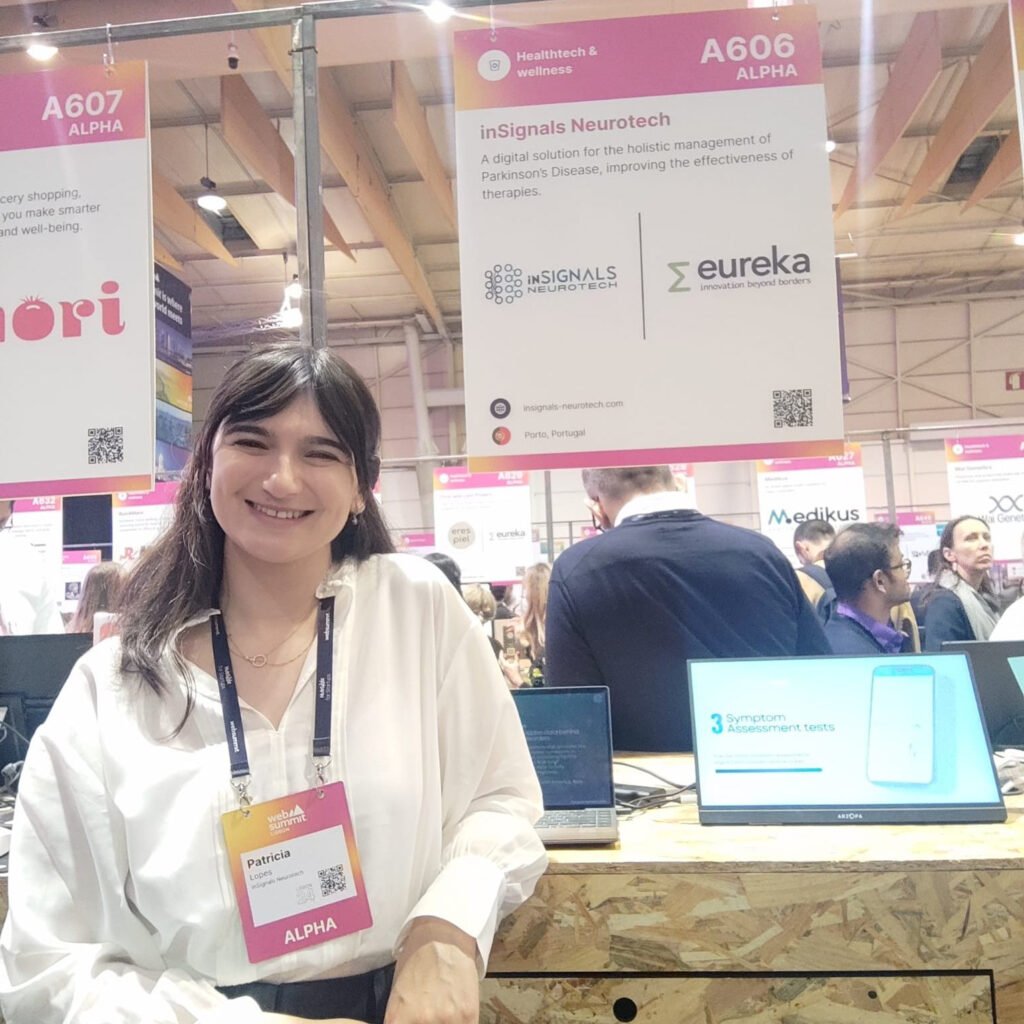
If you’ve ever watched a neurologist assess rigidity at the bedside, you know how much of it still relies on trained hands and expert “feel.” That’s changing. I discovered inSignals Neurotech at Web Summit 2024 in Lisbon, where their live demo immediately stood out for turning subjective assessments into hard data. The team—spun out of the University of Porto / INESC TEC—has built iHandU, a wearable that quantifies wrist rigidity to make Parkinson’s motor assessment objective, reproducible, and actionable. It’s the kind of step-change clinicians, med-device makers, and trial sponsors have been waiting for.
🧩 The Clinical Problem: Variability in Motor Assessments
Parkinson’s disease (PD) is defined by fluctuating motor symptoms—rigidity, tremor, bradykinesia—that change hour to hour and across clinical settings. Traditional assessments are subjective and often inconsistent between raters, which can:
- Complicate DBS planning and intra-op decision making.
- Slow down titration of medications and device therapies.
- Introduce noise into outcomes for clinical trials.
inSignals focuses here first, where precision and repeatability are non-negotiable.
🛠️ The Solution: iHandU—Quantifying Rigidity in Real Time
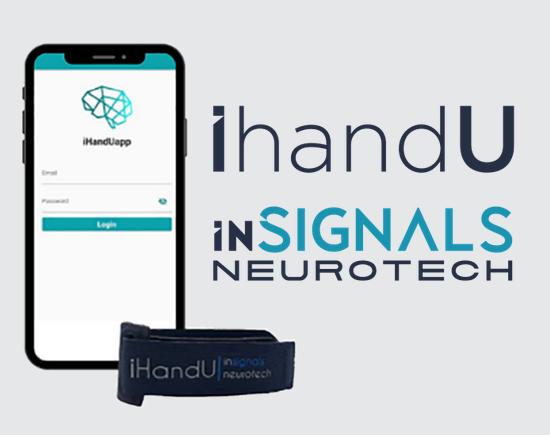
iHandU is a non-invasive, wearable hand device designed to measure wrist rigidity objectively. It pairs with a clinician app and web dashboard to capture signals during standardized maneuvers, then translates them into clear metrics for therapy decisions. In neurology clinics, pharma trials, and operating rooms, that means less guesswork and more data-driven care.
What iHandU enables:
- Objective metrics of rigidity, replacing solely qualitative ratings.
- Decision support for DBS teams during targeting and intra-operative testing.
- Consistent endpoints for Parkinson’s trials, improving sensitivity to change.
Early evidence is encouraging. A recent publication (Aug 12, 2025) reported that using iHandU during STN-DBS correlated with better motor outcomes and fewer dyskinesias/speech disturbances, suggesting that quantified symptom measurement improves intra-op decisions and overall results.
🚀 Why It’s Different: From Spin-Off to Translational Impact
A few things make inSignals stand out:
- Deep academic roots, pragmatic road map. A 2019 spin-off from INESC TEC/University of Porto, inSignals licenses patented wearable motion quantification tech born in the BRAIN Lab and validated in clinical environments.
- Surgical relevance. Frontier IP highlights iHandU’s role in DBS precision, a critical, value-dense moment in PD care where objective data can change outcomes.
- Designed with clinicians. The product direction aligns with needs voiced by neurologists: more precise motor symptom analysis to personalize therapy.
- Traction and recognition. From EIT Health showcases to awards and national programs, the company has been visible within the EU med-tech ecosystem.
For context, several PD wearables exist (e.g., multi-sensor monitors and vibrotactile symptom aids), but iHandU is specifically optimized for rigidity quantification and intra-op/clinical decision support—an under-served, high-impact niche.
👥 The Team Behind inSignals
- João Paulo Cunha, PhD – Co-founder & Chief Scientific Advisor; Professor (FEUP/INESC TEC) and internationally recognized expert in biosignal processing and human motion analysis.
- Company page: [inSignals Neurotech on LinkedIn] and the official website.
(Team also includes clinical and biomedical engineering contributors active across Porto’s neuro and trials community, as evidenced by public updates and program participation.) (LinkedIn)
🧪 Where It Fits in Clinical & Trial Workflows
Use cases we see today:
- DBS centers: Quantified wrist rigidity to guide electrode targeting and intra-op tuning.
- Movement disorder clinics: Standardized motor assessments for longitudinal tracking and therapy adjustments.
- Pharma/biotech trials: Objective, reproducible endpoints to detect treatment effects with smaller cohorts.
Data outputs integrate into clinician dashboards and can pipe to eCRFs or CDISC-aligned datasets with the right middleware—an area ripe for collaboration (more below).
🤝 YOUR R&D × inSignals Neurotech: Collaboration Opportunities
At YOUR R&D, we specialize in full-cycle software and AI for MedTech, from regulated cloud back ends to AI-powered analytics and CI/CD for medical software. We see several high-value collaboration tracks:
1) Data platform & integrations
- Build a secure, scalable, MDR/IVDR-aware cloud to ingest iHandU time-series and provide role-based views (clinic, OR, research).
- eCRF/CDISC/OMOP adapters for pharma trials and registries.
2) AI analytics & decision support
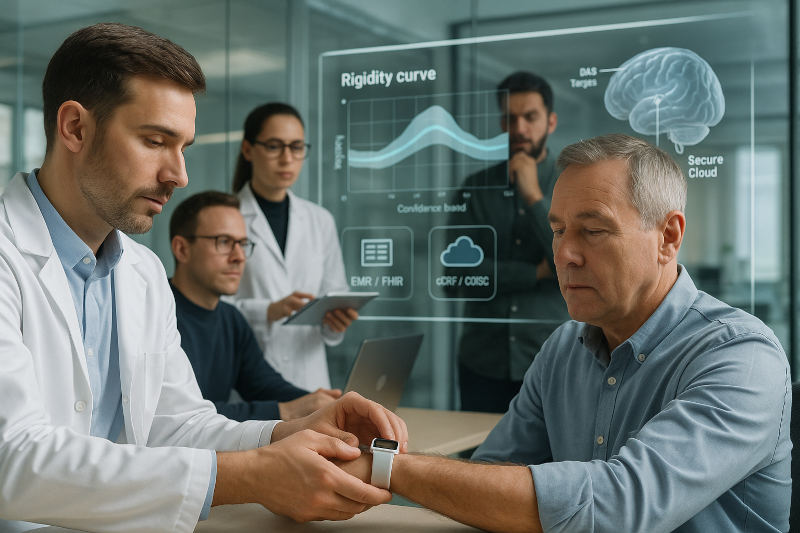
- Develop models to predict ON/OFF fluctuations, rigidity response curves to levodopa/DBS, and personalized therapy recommendations.
- Deliver explainable AI artifacts (saliency, confidence) to support regulatory submissions.
3) Interop & device lifecycle
- FHIR/HL7® integrations with hospital EMRs; DICOM-SR exports for surgical logs; UDI/post-market surveillance dashboards.
- Automated DevOps/QA pipelines for continuous compliance (traceability, test coverage, cyber-hardening).
4) Commercial enablement
- Investor-ready dashboards, trial site portals, and evidence storytelling spanning site activation to KOL engagement—aligned with EU MDR clinical evaluation needs.
🔗 Quick Links
- inSignals website: [insignals-neurotech.com] (company overview & product).
- LinkedIn (company): [inSignals Neurotech].
- YOUR R&D (home): [yourrnd.com] – AI & Software engineering for HealthTech.
- YOUR R&D Blog: [yourrnd.com/blog] – insights on HealthTech product, data, and AI.
#HealthTech #MedTech #Parkinsons #DigitalHealth #AIinHealthcare #SoftwareDevelopment #ClinicalTrials